
Here are the three pillars first, then the 2nd in detail: who is insured, how your savings build up and what to check.
The 3 pillars of Swiss retirement provision at a glance
Retirement in Switzerland rests on three levels: the 1st, 2nd and 3rd pillar. A simple image helps to understand how they fit together and what each one brings.
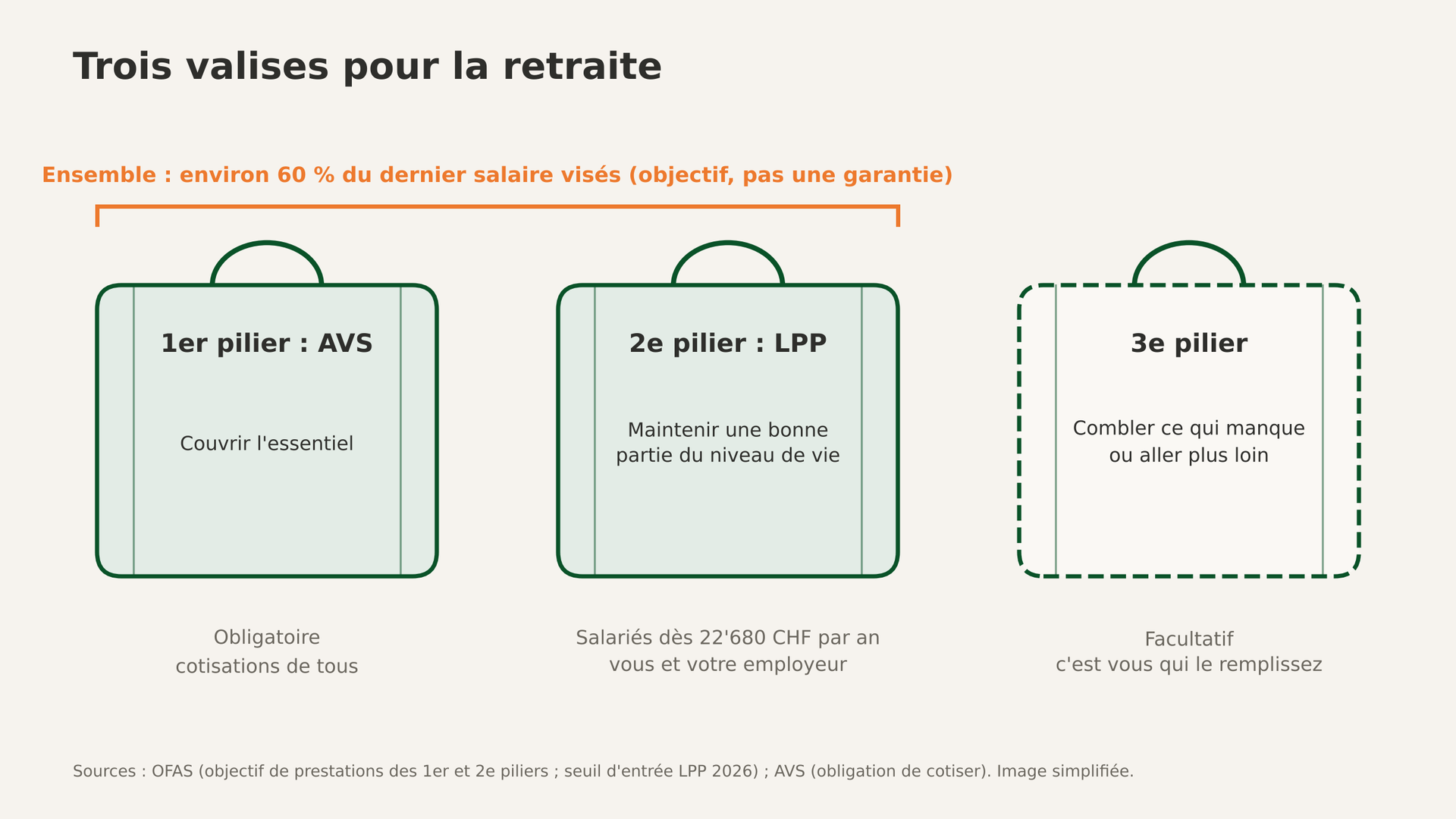
Imagine that your retirement travels with three suitcases. The first, the AHV, is a shared suitcase, filled in particular by everyone's contributions, to cover the essentials. The second, the 2nd pillar, fills up during your career, together with your employer.
Together, these two suitcases aim to maintain a good part of your standard of living. The third, the 3rd pillar, is the one you fill yourself: to make up for what is missing, or to go further.
The 1st pillar: the AHV to cover basic needs
The AHV/AVS, the old-age and survivors' insurance, is the state pension. Its mission is written into the Federal Constitution: to cover basic living needs appropriately for retirees.
Everyone who works in Switzerland pays contributions, as do people who live here without working. In 2026, the AHV old-age pension ranges from CHF 1,260 to CHF 2,520 a month. A 13th pension is now added: one twelfth more over the year, the equivalent of one month's pension.
The 2nd pillar: maintaining your standard of living
The 2nd pillar is the pension fund linked to your job, also called occupational pension provision or BVG/LPP, after the law that governs it. It complements the AHV so that you can maintain your standard of living to a large extent once you retire.
Together, the AHV and the 2nd pillar aim to replace about 60% of your last salary. This is a target, not a guarantee: the result depends on your salary, your career and your pension fund.
The 2nd pillar is not only for retirement. It also protects you in the event of disability or death. If you die, your spouse or registered partner can receive a pension, under certain conditions, or otherwise a one-off sum equal to three annual pensions.
The 3rd pillar: the provision you build yourself
The 3rd pillar is voluntary. It lets you top up the first two according to your means and your goals. It is divided into pillar 3a, which is regulated and tax-advantaged, and pillar 3b, which is more flexible. For an employee with a pension fund, pillar 3a is capped at CHF 7,258 in 2026.
The choice between pillar 3a and 3b depends above all on your situation and your time horizon.
Who is insured under the 2nd pillar?
The 2nd pillar in Switzerland is not compulsory for everyone. It all depends on your status, your age and your salary, with different rules for employees and the self-employed.
Employees above a certain salary
If you are an employee, the 2nd pillar becomes compulsory as soon as your salary exceeds an entry threshold, set at CHF 22,680 a year in 2026.
Age matters too. From 1 January following your 17th birthday, you are covered in the event of death or disability. Saving for retirement, on the other hand, starts on 1 January following your 24th birthday.
The 2nd pillar for the self-employed: optional cover
The 2nd pillar for the self-employed is optional, and you can take out cover if you wish. Without a pension fund, you are entitled to a higher pillar 3a: up to 20% of your earned income, with a maximum of CHF 36,288 in 2026.
For the self-employed, having no 2nd pillar is therefore not a dead end. It simply calls for a more active approach to building your retirement provision.
Part-time work and low salaries: possible gaps
A low salary may stay below the entry threshold. And even above it, part of the salary is not saved, as we will see below. Part-time work, which is much more common among women, can therefore lead to a much lower 2nd pillar pension. Your pension certificate lets you measure this gap.
How is your capital built up?
The 2nd pillar works mainly like personal savings. Every year, money is paid into your retirement savings account, then earns interest, until you retire.
The coordinated salary: the insured part of your pay
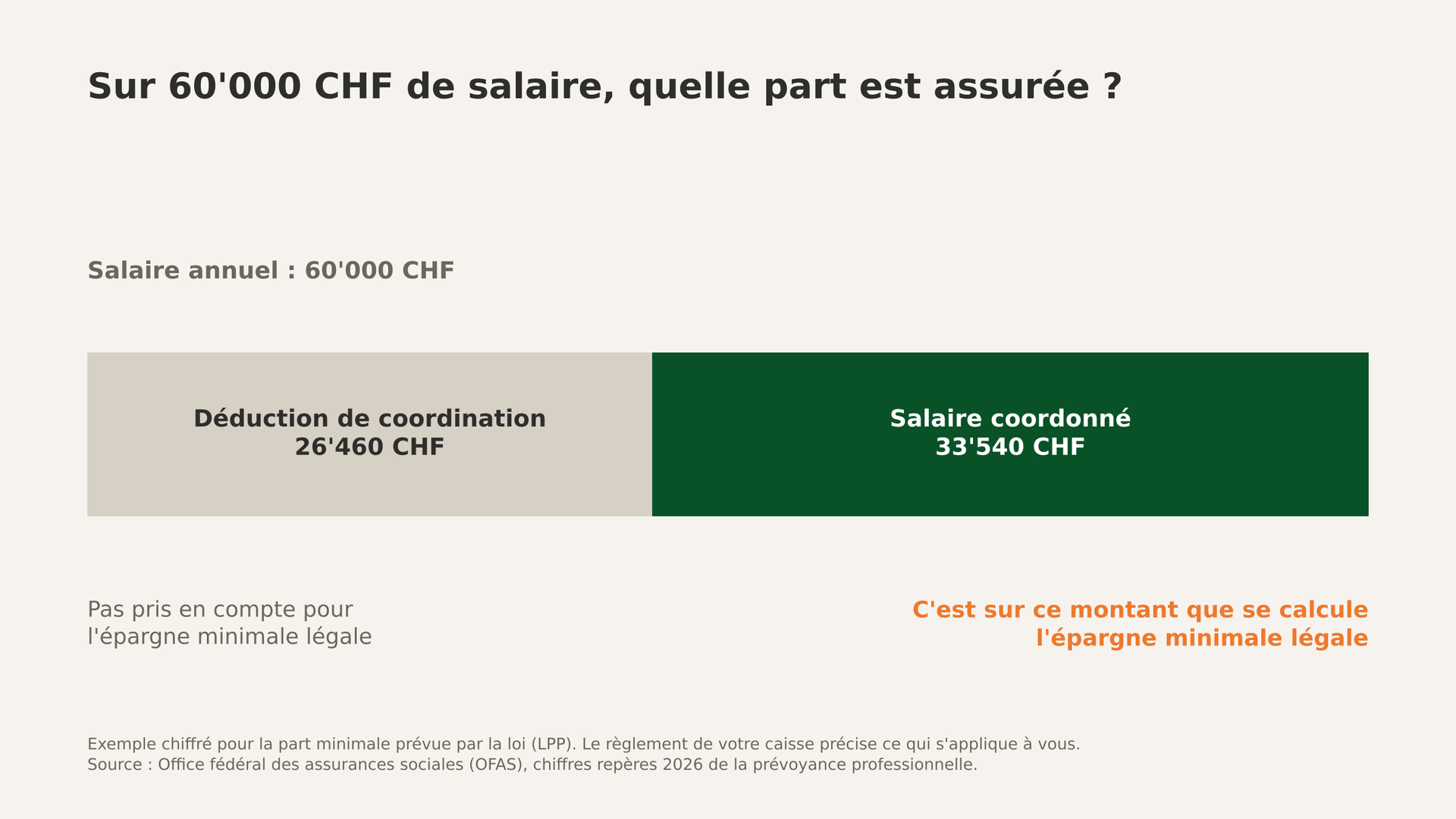
Not all of your pay is insured. The law first deducts a fixed amount, called the coordination deduction: CHF 26,460 in 2026. What remains is called the coordinated salary.
Take an annual salary of CHF 60,000. Once the coordination deduction has been taken off, the coordinated salary is CHF 33,540. It is on this amount that the minimum savings required by law are calculated, not on the CHF 60,000.
Contributions that rise with age
Every year, your pension fund pays a percentage of your coordinated salary into your account. This percentage rises with age: the closer you get to retirement, the higher it is.
These contributions are shared with your employer, and your share is deducted directly from your salary. Your pension fund's regulations set out the exact split.
Interest and pension: what happens to your savings
The money you build up earns interest. For the minimum savings required by law, the minimum interest rate is 1.25% in 2026.
At retirement, your capital can be converted into a pension paid every month. For this, the law sets a conversion rate of 6.8% on these minimum savings. With a hypothetical capital of CHF 300,000, that would give a pension of CHF 20,400 a year, or CHF 1,700 a month.
In principle, you receive your 2nd pillar at 65. Some pension funds allow it from 58 in the case of early retirement, and you can wait until 70 if you keep working. Pension or lump sum: your pension fund will tell you the options provided for in its regulations.
Changing jobs, reading your certificate: good habits
Your 2nd pillar follows you throughout your career. Two moments deserve particular attention: changing employer and reading your pension certificate every year.
What happens when you change jobs
Your savings do not stay with your former employer. This money, called the vested benefit, must be transferred to your new employer's pension fund.
Your former pension fund will ask you for the details of the new one. If it does not, ask your new employer for them and pass them on yourself.
Between two jobs, during training or a period of unemployment, your money stays blocked in a vested benefits account. If you do not open one, it is automatically paid to a foundation set up for this purpose, the Substitute Occupational Benefit Institution. It is then better to contact it to recover your money and get a better interest rate.
Reading your pension certificate
Every year, your pension fund must inform you about your entitlements, your coordinated salary, your contribution rate and your savings. It is required to do so by law, and this information appears on your pension certificate.
A few minutes are enough to spot the essentials.
- Your retirement savings, meaning the savings already built up
- Your coordinated salary
- The pension expected at retirement
- Your cover in the event of disability or death
This document also helps you spot any pension gaps early, meaning holes in your retirement savings.
Conclusion
The 2nd pillar is a major source of savings, and yet it is often poorly understood. Together with the AHV, it aims to maintain a good part of your standard of living in retirement.
Remember three ideas. The 2nd pillar depends on your status and your salary. Your savings build up every year, together with your employer. And they follow you from one job to the next.
To take a first step today, find your latest pension certificate and write down your coordinated salary and your retirement savings.
These two figures are already enough to see your retirement more clearly.
To get started: the Academy's Foundations programme, free, helps you lay the groundwork for your finances at your own pace.
To go further: the Academy's one-on-one support helps you structure your financial decisions, such as preparing for retirement.
FAQ
Is the 2nd pillar compulsory?
For employees, yes, as soon as their salary exceeds CHF 22,680 a year in 2026. With a lower salary, your employer can still insure you on a voluntary basis. The self-employed are not obliged to join, but they can take out cover if they wish.
How much does my employer pay into my 2nd pillar?
In principle, at least as much as you. Contributions must be shared equally, and your employer can choose to pay more than half. Your pension fund's regulations and your pension certificate show the exact split that applies to your situation.
What happens to my 2nd pillar if I change jobs?
It follows you. Your savings are transferred to your new employer's pension fund, and this transfer is compulsory. If you do not yet have a new job, they wait in a vested benefits account. Remember to check on your new certificate that the amount transferred matches the old one.
Can you access your 2nd pillar before retirement?
Yes, but only in certain cases: to buy your main home, to become self-employed or if you leave Switzerland for good. If you move to a European Union country, part of the money stays blocked until retirement. And every withdrawal reduces your future benefits.
⚠️ Important notice ⚠️
The information presented in this article is provided for purely informational and educational purposes. It does not in any way constitute a personalised recommendation, investment advice, an offer or a solicitation to buy or sell financial products.
Any investment decision should be made after a thorough analysis of your personal situation, your objectives and your risk profile, and may require the advice of an authorised financial adviser.
Past performance is no guarantee of future results. Investments involve risks, including the risk of capital loss.