
Understanding an ETF is not just about knowing a definition: it means understanding how a tool works that can profoundly change the way you invest, save and build your financial future. At AdvisorOne Academy, we believe financial education is not about following trends, but about understanding what you are doing before you invest your money.
What exactly is an ETF?
ETF stands for exchange-traded fund. In practice, an ETF is a basket of investments grouped together in a single financial product, which you buy and sell on the stock exchange just like a share.
When you buy an ETF, you are not investing in a single company, but in dozens, sometimes hundreds or even thousands of companies at the same time.
Example: an S&P 500 ETF
An S&P 500 ETF lets you automatically invest in 500 of the largest US companies, such as:
- Apple
- Microsoft
- Johnson & Johnson
- Coca-Cola
... all in a single transaction.
This is what we call diversification: not putting all your eggs in one basket.
If one company goes through a difficult period, its impact on the portfolio as a whole remains limited, since it only represents a small part of the total investment.
Why are ETFs so popular with investors?
ETFs have grown spectacularly over the last twenty years for a simple reason: they make investing more accessible, simpler and often cheaper.
At the end of July 2026, more than USD 23 trillion was invested in ETFs worldwide, a record according to the specialist research firm ETFGI.
Diversification
Before ETFs, building a truly diversified portfolio required a lot of capital, time and advanced knowledge.
Today, with just a few dozen francs, a global ETF can give you exposure to more than a thousand companies spread across several countries: about 1,250 for an ETF that tracks the MSCI World, the best-known global index.
This diversification reduces the risk linked to a single company or a single sector.
Much lower fees
Most ETFs work on a principle called passive management.
Unlike traditional funds, which try to "beat the market", ETFs simply track a stock market index.
This requires less human intervention and therefore leads to much lower fees.
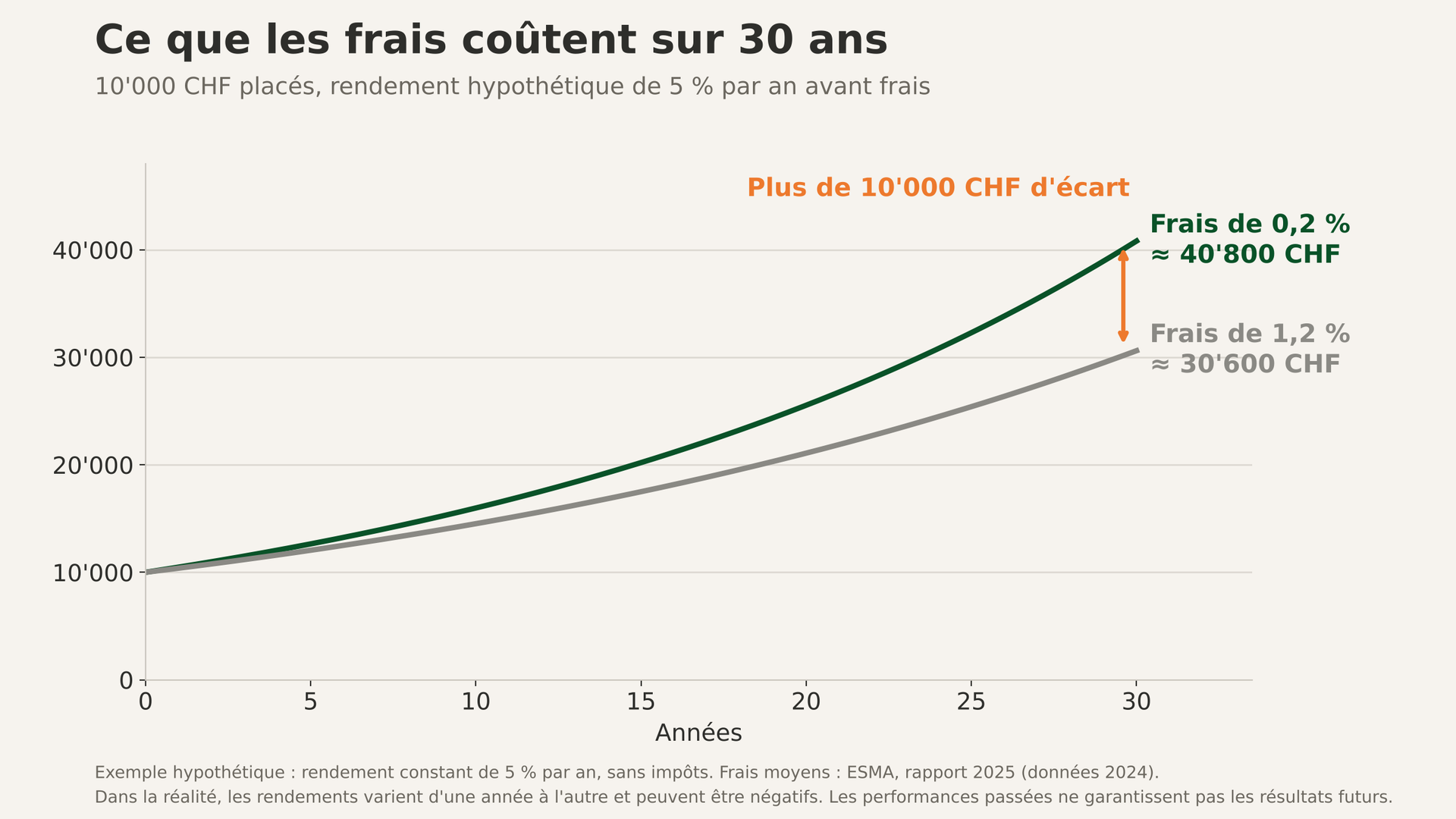
According to ESMA, the European Securities and Markets Authority, ETFs that track an equity index cost about 0.2% a year on average in the European Union in 2024, compared with about 1.2% for actively managed equity funds.
Over several decades, this difference weighs heavily. Take an example: CHF 10,000 invested for 30 years with a hypothetical return of 5% a year would grow to about CHF 40,800 with fees of 0.2%, compared with about CHF 30,600 with fees of 1.2%. That is more than CHF 10,000 of difference, purely because of fees.
How does an ETF work?
Most ETFs track a stock market index. An index is simply a list of companies used as a benchmark to measure how a financial market is performing.
A few well-known examples:
- The S&P 500 → large US companies
- The CAC 40 → large French companies
- The SMI → large Swiss companies
- The MSCI World → international companies from developed countries
When the index rises, the ETF rises.
When the index falls, the ETF falls.
It works mechanically. An ETF does not try to do better than its index: it tries to track it as closely as possible, after fees.
This is what we call passive investing.
Distributing or accumulating ETF?
The companies held in an ETF often pay dividends, a share of their profits. A distributing ETF pays them out to your account regularly. An accumulating ETF automatically reinvests them in the fund.
Neither form is better in itself. The first suits someone who wants an income, the second someone who wants to let their capital grow without thinking about it. The ETF's name often shows which it is with the letters "Dist" or "Acc".
Are ETFs suitable for beginners?
In many cases, yes. ETFs are often mentioned as a suitable first investment, provided you understand what they contain and how long you plan to keep them.
They let you build a diversified portfolio without having to analyse dozens of companies one by one.
This is also why they are often used in long-term investment strategies, especially when you are trying to build solid foundations and work out where to start when you are new to investing.
Investing regularly with DCA
Many investors choose to invest in ETFs regularly using an approach called DCA (dollar-cost averaging, or regular scheduled investing).
The principle is simple.
- Invest a fixed amount
- At regular intervals
- Whatever the market is doing
This way of investing regularly means you avoid waiting for "the perfect moment" to invest.
When markets fall, the same amount buys more units, that is, fractions of the ETF.
When markets rise again, these units gain value.
Over the long term, this approach smooths out the average purchase price while bringing valuable discipline.
This method does not guarantee a gain: if markets fall for a long time, the units already bought also lose value, and you need to be able to wait.
Do ETFs carry risks?
Yes. And this is an essential point. A diversified ETF is not a risk-free investment. Diversification protects against the risk linked to a single company, but it does not protect against global crises in the financial markets.
Markets can fall too
During the 2008 financial crisis, most of the world's markets fell sharply.
In 2022, the S&P 500 lost about 18% over the year, according to S&P Dow Jones Indices.
An S&P 500 ETF therefore also lost about 18%.
For an investor in Switzerland, currency risk also has to be taken into account. An S&P 500 ETF is invested in dollars: if the dollar falls against the franc, the value of the investment in CHF falls too, even if the index does not move.
Understanding this before you invest is fundamental.
At the Academy, we often point out that an ETF is not an investment strategy in itself. It is a tool. The real question is always this one: why are you investing, over what time horizon, and with what level of acceptable risk?
ETFs: a powerful tool, but not a magic one
ETFs have profoundly transformed investing. What was once reserved for large investors is today within the reach of almost everyone.
They have made these things accessible:
- diversification
- lower fees
- long-term investing
- exposure to global markets with modest capital
But their popularity has also created a dangerous illusion: believing that an ETF is automatically simple, profitable and risk-free.
That shortcut is wrong.
ETFs are tools. How effective they are depends entirely on how they are used.
Conclusion
The best decision a beginner investor can make is not to look for "the best ETF".
It is first to understand what they are investing in.
Because a good financial decision is not necessarily the most profitable one. Above all, it is a decision that is understood, owned and consistent with your life goals.
To take a first step today, pick an ETF you have heard of and find its factsheet. Which index does it track, how many companies does it hold, and what are its annual fees?
These three answers are already enough to know what you are buying.
To get started: the Academy's Foundations programme, free, helps you build solid foundations before you invest.
To go further: the Academy's one-on-one support helps you structure this understanding and apply it to your own situation.
FAQ
Can you lose money with an ETF?
Yes. An ETF follows the financial markets, so if markets fall, the ETF falls too. Diversification limits the risk linked to a single company, not the risk of a general crisis. That is why it is better to invest only money you will not need in the short term, and to think in terms of several years.
What is the difference between a share and an ETF?
There is no ideal ETF for everyone. Broad, diversified ETFs, such as some global ETFs or S&P 500 ETFs, are often used by beginner investors for their simplicity and diversification. Before choosing, look at the index tracked, the annual fees, the currency and what the ETF does with dividends: whether it pays them out or reinvests them.
What is the difference between a share and an ETF?
A share represents a single company, while an ETF groups several companies in one financial product. With a share, your investment depends entirely on that company. With an ETF, it is spread across dozens or even thousands of companies, yet both are bought the same way on the stock exchange, through how a share is listed and priced.
Can you invest in ETFs for the long term?
Yes. ETFs are often used in gradual, long-term investment strategies thanks to their low fees and diversification. Over time, lower fees leave more of the return to the investor, and time allows gains to generate further gains in turn. This is also why starting early matters more than starting with a lot.
⚠️ Important notice ⚠️
The information presented in this article is provided for purely informational and educational purposes. It does not in any way constitute a personalised recommendation, investment advice, an offer or a solicitation to buy or sell financial products.
Any investment decision should be made after a thorough analysis of your personal situation, your objectives and your risk profile, and may require the advice of an authorised financial adviser.
Past performance is no guarantee of future results. Investments involve risks, including the risk of capital loss.