
Diversification is not a strategy reserved for professional fund managers. It is a basic principle open to any investor, which reduces risk without necessarily reducing the expected return. You still need to understand what diversifying really means, and what it does not do.
What is diversification and why does it work?
The principle is simple: diversifying means not concentrating all your capital on a single source of risk. But in practice, how should you spread your investments, and how far should you go?
Take two people. The first invests CHF 10,000 in the shares of a single Swiss company. The second invests the same amount in several hundred companies, spread across different sectors and different countries.
Both are exposed to market fluctuations. But the first depends entirely on the fate of one company: a scandal, a loss of market share or a poor strategic decision can weigh heavily on their wealth. For the second, an event like this will generally have only a limited impact on the whole.
Correlation between assets: the real engine of diversification
Correlation measures the tendency of two investments to move together. If two assets almost always rise and fall at the same time, their correlation is high. If they move differently, it is lower.
This principle lies at the heart of modern portfolio theory, developed as early as 1952 by Harry Markowitz, who received the Nobel Prize in economics in 1990, together with William Sharpe and Merton Miller. His work showed that the risk of a portfolio does not depend only on the risk of each investment, but also on how they move in relation to one another.
A portfolio of ten companies from the same sector holds ten shares, but they can all be hit at the same time by the same crisis or the same regulation. Diversifying is therefore not about owning many investments: it is about owning investments exposed to different drivers of risk.
Specific risk vs market risk: what you can eliminate and what you cannot
There are two main categories of risk.
What is known as specific risk is linked to a company, a sector or sometimes a country: the loss of a major client, a scandal, a new regulation. Sufficiently broad diversification can reduce it considerably.
Market risk, on the other hand, affects a large share of investments at the same time. This risk does not disappear because you own more securities: diversification reduces it in part, but cannot eliminate it.
The different dimensions of diversification
Good portfolio diversification is thought through at several levels. It is not limited to the number of investments, it looks at what they have in common and what sets them apart.
By asset class: shares, bonds, property, cash
A portfolio can combine different asset classes. Shares, bonds, property or a simple cash reserve: each plays a different role.
Shares let you share in the growth of companies, with attractive return potential over the long term, but sometimes sharp fluctuations. Bonds, which are loans made to governments or companies, behave differently, even though they can also lose value. Property brings another kind of exposure, either directly or through funds. Finally, cash serves short-term needs and unexpected expenses.
By region: avoiding home bias
Switzerland, Europe, the United States, Asia, emerging markets: each economy has its own structure, dominant companies, currency and cycles. The MSCI World brings together large and mid-sized companies from 23 developed markets and covers about 85% of the free float-adjusted market capitalisation of each of them. A global index does not eliminate risk, but it stops an equity portfolio from relying on a single country.
By sector: not being 100% exposed to one sector
Technology, finance, healthcare, industry, energy: sectors do not all react in the same way. Rising interest rates hurt some activities more than others, and a rise in the oil price benefits some companies while weakening others. A portfolio spread across several sectors cushions these differences.
By time horizon: short term and long term follow different logic
Diversification also depends on when the money will be needed. For an expense planned in six months, the priority is to keep the capital available and stable. For a project twenty years away, it becomes possible to accept fluctuations in exchange for higher return potential.
Home bias: a trap that is particularly common in Switzerland
We naturally tend to prefer what we know. In finance, this tendency has a name: home bias, or the preference for investing in your own country.
The tendency to overweight Swiss shares because they feel "more familiar"
Investing in a large Swiss company feels reassuring: you know its name, you sometimes use its products, and its shares are listed in francs. But knowing a brand does not make the investment any less risky.
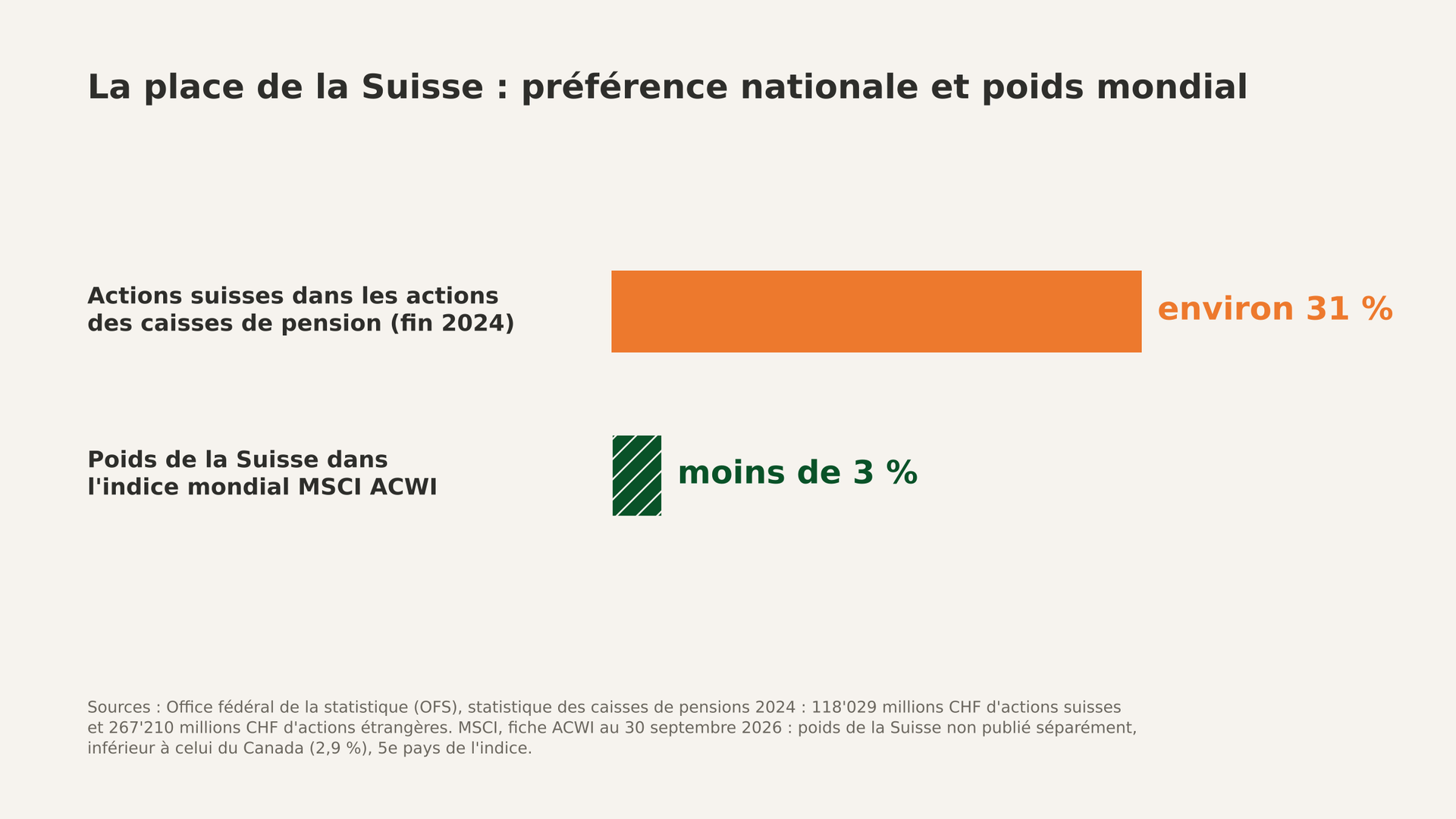
Swiss pension funds offer a good example. At the end of 2024, about 31% of the shares they held were Swiss, according to the Federal Statistical Office, whereas Switzerland accounts for less than 3% of the MSCI ACWI global index.
The Swiss market is solid, and the Swiss Performance Index (SPI) is its broadest benchmark. But it is also highly concentrated.
The 20 largest and most liquid Swiss shares account for about 80% of the capitalisation of the Swiss equity market. Investing only in Switzerland therefore means depending on a single market and a handful of large companies.
For a Swiss investor, geographical diversification does not mean giving up on Swiss companies. It is rather about asking what place they should have in a global portfolio.
Why a strong economy like Switzerland's does not protect against a global crisis
The Swiss economy is very open. Some large Swiss companies generate most of their business abroad and remain exposed to international cycles. And when a shock becomes global, borders do not protect a portfolio: many regions and asset classes can then fall at the same time.
How to start diversifying in practice with limited means
A few decades ago, holding hundreds of international companies required substantial capital. Today, it is possible even with small amounts, once your reserve for unexpected expenses is in place. That is good news when you are just starting to invest.
ETFs as a first accessible diversification tool
ETFs, or exchange-traded funds, let you invest in a whole range of securities through a single instrument. An ETF that tracks a global index can give access to several hundred, or even more than a thousand, companies.
But an ETF is not automatically diversified. An ETF dedicated to US technology companies remains concentrated on one sector and one country, and an ETF of Swiss shares remains exposed to Switzerland. So you always need to look at what it contains: countries, sectors, number of companies and the weight of the largest holdings.
A simple allocation example (for illustration only, not a personalised recommendation)
Someone organising long-term capital could think in terms of "building blocks": one part in broadly diversified international shares, one part in bonds, possibly some exposure to property, and cash. Within the shares, they would then check that they do not depend on a single country or a single sector.
The size of each block depends on the time horizon, goals, financial capacity and tolerance for fluctuations. There is therefore no universal allocation. What matters is that every holding in the portfolio has a role.
Conclusion
Diversification does not guarantee gains: it manages risk. Nobody knows for sure which company, sector or country will do best tomorrow. Diversifying simply means refusing to make all your wealth depend on a single bet. It plays out across asset classes, countries and sectors, without losing sight of your time horizon.
To take a first step today, list your current investments, including your pillar 3a. For each one, note its asset class, its country and its main sector. You will quickly see where your risk is concentrated.
A portfolio does not need to be perfect to be better spread.
To get started: the Academy's Foundations programme, free, helps you lay the groundwork before going further with investing.
To go further: the AdvisorOne Diagnostic takes a few minutes to show you where you stand, with no commitment.
FAQ
Can you diversify too much?
Yes, to some extent. Piling up products that ultimately invest in the same companies makes a portfolio more complex without making it more diversified. Owning five ETFs does not mean being five times better diversified if they mainly hold the same shares. What counts is your real exposure, not the number of holdings.
Is a single global ETF enough to diversify your portfolio?
A global ETF offers very broad diversification within shares, but not across every dimension. Some "world" indices only cover developed markets, and the smallest companies are often left out. Above all, an ETF made up of 100% shares remains a 100% equity investment: it does not replace diversification across asset classes.
Does diversification protect you in a global crisis?
It limits certain risks, but does not offer absolute protection. During a major crisis, markets can move more closely together, and many assets can fall at the same time. Diversification remains useful, because it reduces your dependence on a single company, a single country or a single scenario.
Should you diversify differently depending on your investment horizon?
Yes. The closer the deadline, the less you can afford a sharp temporary fall. Conversely, a horizon of several decades makes it easier to ride out fluctuations. Good diversification therefore starts with your goals and the time you have to reach them.
⚠️ Important notice ⚠️
The information presented in this article is provided for purely informational and educational purposes. It does not in any way constitute a personalised recommendation, investment advice, an offer or a solicitation to buy or sell financial products.
Any investment decision should be made after a thorough analysis of your personal situation, your objectives and your risk profile, and may require the advice of an authorised financial adviser.
Past performance is no guarantee of future results. Investments involve risks, including the risk of capital loss.